At a glance
- If you co-produce with Italy, AI rules already affect your contracts: the Italian tax credit requires AI consent clauses with authors and performers, and the 2026 selective funds exclude AI-made screenplays and artistic materials.
- A film made with AI tools is protected in Italy only if it results from human creative work, so that work needs to be documented. Owning a film, however, is not the same as clearing it.
- Deepfakes of real people or places must be disclosed under the EU AI Act, in fiction too, and the rule also reaches producers outside the EU whose films are released in Europe.
Updated October 2026, after MIA in Rome.
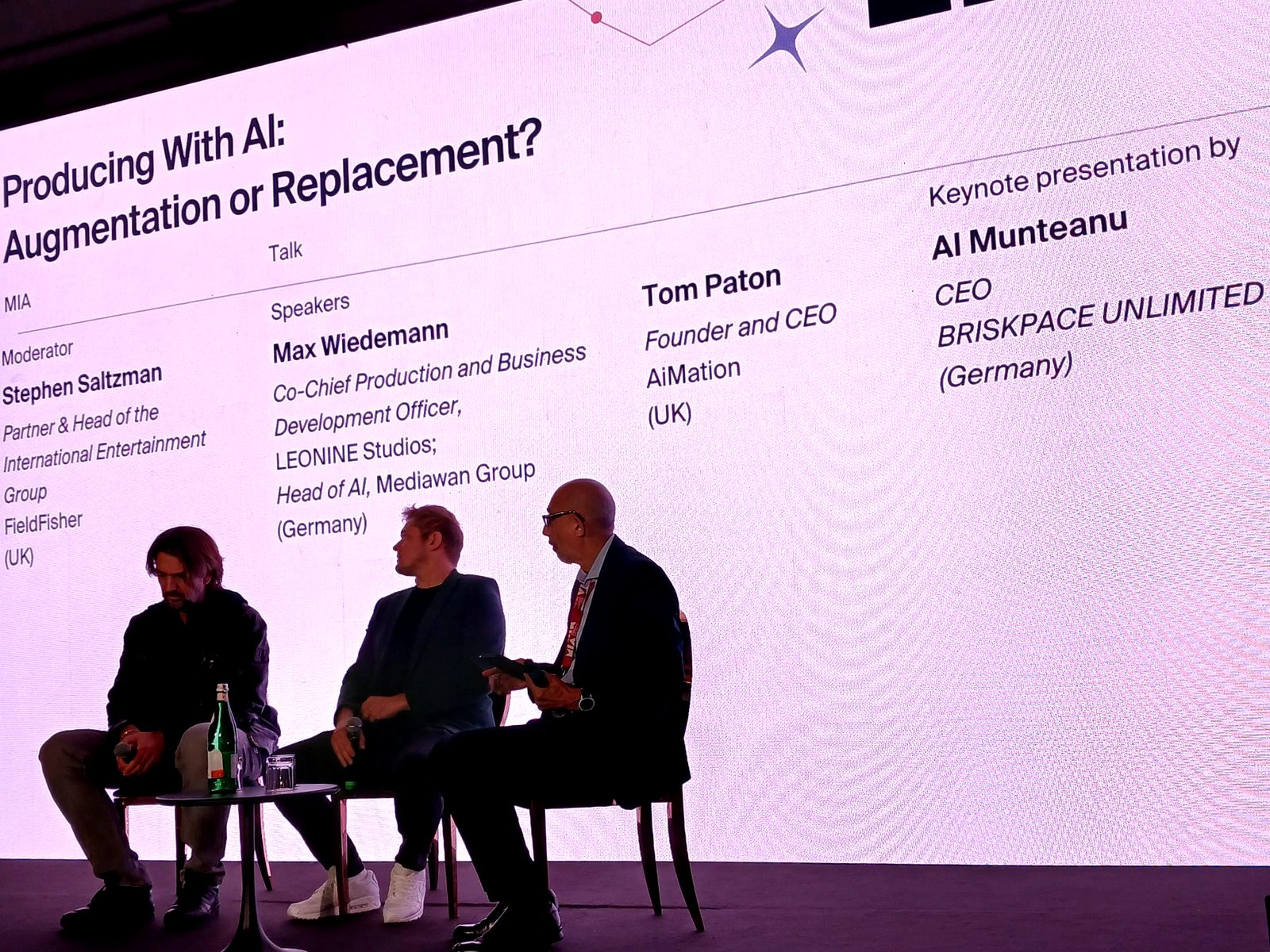
If you are planning a co-production with Italy, AI is no longer a question for the future. Over the last two years Italian and EU rules have started to decide whether the Italian share of your budget gets public money, who owns the finished film, and what you have to tell the audience. At MIA, Rome’s audiovisual market, producers on the AI panel this October described AI as “just a tool”. Italian law agrees, up to a point. This page explains where that point is, and what to check before you sign with an Italian partner.
The money: AI clauses are now a tax credit condition
Italy’s production tax credit, on which much of Italian production depends, now comes with AI conditions. Under the 2024 tax credit decree and the April 2025 guidelines of the Ministry of Culture’s Directorate-General for Cinema, every contract with authors and performers must include a clause letting them refuse the use of their work, image or performance by AI systems. Without it, the application is inadmissible. The parts of the film made with AI must be declared in the credits, on pain of losing the credit, and AI costs for above-the-line creative work are not eligible, except special effects relating to lead actors. Similar rules apply to Italian service companies under the international tax credit.
Selective funding is stricter still. The Ministry’s 2026 selective calls exclude projects whose screenplays and artistic materials are made using AI systems, mood boards included, even if the material was prepared by the foreign partner.
For a co-producer this means one thing in practice: the AI clauses cannot live only in your Italian partner’s contracts. If your writers, your lead actors or your VFX vendor work on the Italian share, their agreements need to match. Our guide to Italian film tax credits covers the rest of the incentive.
Ownership: document the human work
In 2025 Italy became the first EU country to pass a national AI law alongside the AI Act. Law 132/2025 rewrote the first paragraph of Article 1 of the Italian Copyright Act, unchanged since 1941: works made with AI tools are protected, provided they result from the author’s own intellectual work. A prompt alone does not qualify. Choices, discarding, rewriting and editing do. The Court of Cassation had already said as much in 2023, when it held that an image created with software for the Sanremo Festival stage was a protected work because it reflected the author’s own choices.
If ownership depends on human work, you need to be able to prove it. Drafts, versions and notes on what was kept and what was cut are now part of the chain of title, and financiers and E&O insurers will increasingly ask for them.
Clearance: owning a film is not clearing it
Human authorship tells you who owns the film. It does not tell you whether the film, or the model behind it, has taken someone else’s work. In April 2026 the Court of Milan, in the first Italian decision after the new law, found it “evident” that training an AI system on another company’s images without consent infringed its rights of reproduction and adaptation. The Copyright Act now says the same: training is lawful only within the text and data mining exceptions, including the rightholder’s opt-out. If your project uses footage, clips or images from third parties, our clip clearance service in Italy explains how we check them.
On screen: deepfakes must be disclosed, in fiction too
Since 2 August 2026, Article 50 of the EU AI Act requires deepfakes, meaning AI content that realistically depicts existing people, places or events, to be disclosed. In an evidently artistic or fictional work the label can be discreet and must not spoil the film, but it has to be there. The rule also applies to providers and deployers outside the EU when the output is used in the Union: a UK or US production released in Europe is not out of scope. And in Italy, spreading a harmful deepfake of a real person without consent is now a crime, punishable by one to five years in prison.
Before you sign with an Italian partner
- Agree who documents the human creative work on the project, and how.
- Align the AI consent clauses in both co-producers’ agreements with authors and performers.
- Ask vendors for warranties on their AI tools and training data.
- Plan how you will disclose any synthetic real person or place.
- Before applying for Italian selective funds, check that no AI-made material is in the dossier.
How we can help
DANDI.media | Entertainment Law & Co-Production Strategies is an entertainment law firm in Rome and Genoa that works with foreign producers bringing projects to Italy. We review co-production and talent agreements on both sides, align the AI clauses with Italian tax credit and selective fund requirements, prepare chain of title and clearance opinions for financiers and insurers, and structure co-productions under Italy’s bilateral treaties, such as the Italy–Canada treaty, and the revised Council of Europe Convention on Cinematographic Co-production.
To discuss a project, book a consultation or write to claudiaroggero@dandi.media or donatodipelino@dandi.media.
Tom Paton of AiMation closed the MIA panel with the best line of the week: selling socks to squirrels is a bad idea, and if an AI tells you otherwise, don’t believe it. The same goes for legal comfort. Get the paperwork right before the camera rolls.
Claudia Roggero and Donato Di Pelino wrote on these topics in “In the Age of Artificial Intelligence, Italy Chooses the Human Element: The Rewriting of Article 1 of Its Copyright Act”, Entertainment Law Review (2026) 37 Ent. L.R., Issue 8.
FAQ
Do Italian film contracts need AI clauses for the tax credit?
Yes. Contracts with authors and performers must let them refuse the use of their work, image or performance by AI systems, or the tax credit application is inadmissible. The parts of the film made with AI must be declared in the credits.
Do the AI clauses apply to the foreign co-producer’s contracts?
The requirement applies to the Italian applicant, but if foreign authors, performers or vendors work on the Italian share, their agreements should match, or the Italian partner’s application may be at risk.
Is a film made with the help of AI protected by copyright in Italy?
Yes, if it results from the author’s own intellectual work, under Article 1 of the Italian Copyright Act as amended by Law 132/2025. Content generated from a prompt alone is not protected.
Does the AI Act apply to a UK or US producer co-producing with Italy?
It can. The AI Act applies to providers and deployers outside the EU when the output is used in the Union, so a film released in Europe must disclose any deepfake of real people, places or events.
Useful links
| Resource | Link |
|---|---|
| Italian film tax credits | DANDI.media guide |
| Italy–Canada co-production treaty | DANDI.media guide |
| Clip clearance in Italy | DANDI.media service |
| Book a consultation | claudiaroggero.youcanbook.me |
| Law no. 132/2025 on artificial intelligence | Normattiva |
| Italian Ministry of Culture – Cinema and Audiovisual (DGCA) | cinema.cultura.gov.it |
| AI Act, AI-generated content | European Commission |
Dandi Law Firm provides legal assistance in several Practice Areas. Check out our Services or contact Us!