At a glance
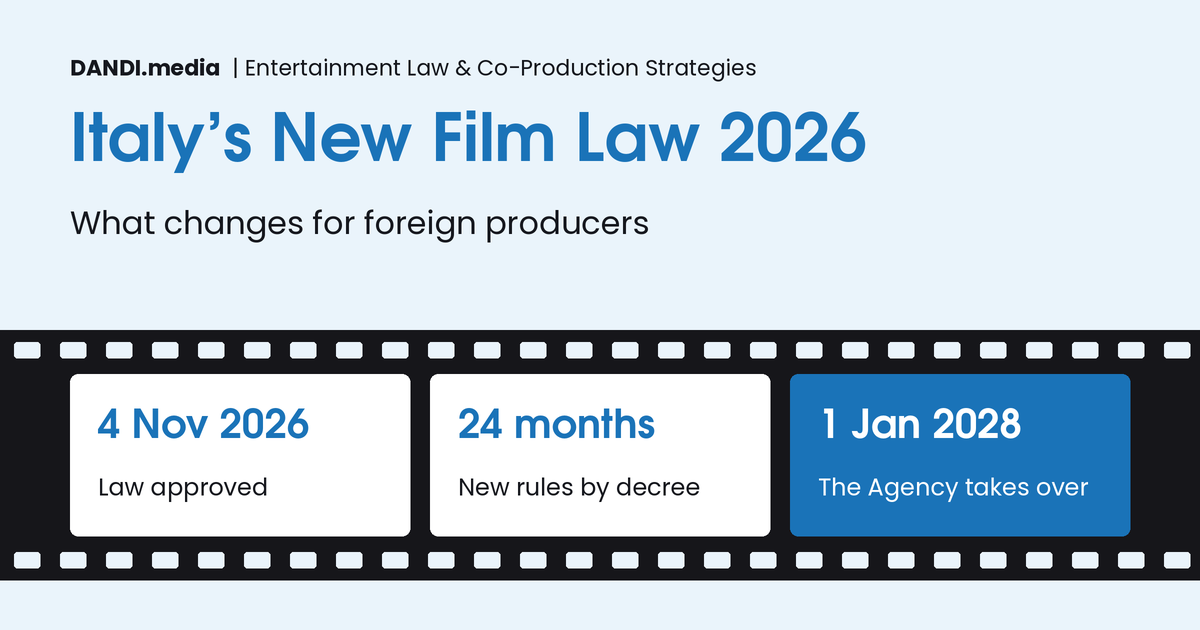
- On 4 November 2026 the Italian Senate gave final approval, unanimously, to the reform of Italy’s film and audiovisual law. It now awaits publication in the Official Journal.
- From 1 January 2028 a new Film and Audiovisual Agency will take over the operational work of the Ministry of Culture’s Directorate-General for Cinema (DGCA), including the management of public support.
- The tax credit, the AI clauses and the current application procedures do not change today. The Government has 24 months to rewrite the rules through delegated decrees, including rules on the use of AI in films.
Updated November 2026.
Ten years after the 2016 film law, Italy has a new framework for its film and audiovisual industry. The reform passed the Chamber of Deputies on 10 September 2026 and the Senate confirmed the same text on 4 November, with 123 votes in favour and none against. For a foreign producer working with Italy, most of the practical rules stay the same for now. What changes is who will run the system, and the direction of the rules that will follow.
What changes: a new Agency from 2028
The reform creates the Film and Audiovisual Agency (Agenzia per il cinema e l’audiovisivo), a public body based in Rome, supervised by the Ministry of Culture and operational from 1 January 2028. It takes over the operational functions of the DGCA, which today handles tax credit applications, selective funding and the recognition of Italian nationality for films and co-productions. The Ministry keeps policy direction and supervision.
Until the Agency is up and running, nothing changes on your side of the desk: applications, co-production approvals and tax credit filings still go to the DGCA.
A Forum that will watch AI
The Superior Council for Cinema and Audiovisual is abolished and replaced by the Film and Audiovisual Forum, a permanent consultative body of 16 unpaid members. Half are experts appointed by the Minister, partly through a public call; the other half are designated by associations representing authors, workers, independent producers, distributors, exhibitors, audiovisual platforms and the video game sector. Among its tasks, the Forum gives opinions on the rules for the sector and monitors the impact of digital technologies and AI systems.
Selective funding: commissioners drawn by lot
From 2028, projects applying for selective funding will be assessed by a commission of 20 experts, drawn by lot, with gender balance, from a shortlist of 30 prepared by a committee of the Forum. Commissioners serve for one year and must wait three years before applying again. The aim is to reduce conflicts of interest.
AI enters the film law
Among the general principles of the reform, public policy must promote the responsible use of AI in film and audiovisual production, with transparency towards the public and protection for authors, performers and rightholders. The delegation to the Government goes further: the new decrees must regulate the use of AI in films and audiovisual works, ensuring transparency, consent for the use of artistic performances and the protection of rights.
This builds on rules already in force. Today, contracts with authors and performers must allow them to withhold consent to the use of their work, image or performance by AI systems, or the tax credit application is inadmissible; and Law no. 132/2025 amended Article 1 of the Italian Copyright Act, which now protects AI-assisted works only when they result from the author’s own intellectual work. The direction is clear: consent and transparency will become more, not less, central to Italian film contracts.
What does not change yet
The reform is largely a framework. Within 24 months the Government must adopt delegated decrees to rewrite the whole discipline of the sector, from three-year planning and a national plan for cinemas to anti-piracy measures and support for independent production and video games. A second delegation covers social protection for entertainment workers.
Until those decrees are adopted, the current rules apply: the tax credit for foreign productions and for Italian co-producers, the AI clauses required for eligibility, the co-production procedures and the deadlines. Our guide to Italian film tax credits describes them as they stand today.
What this means if you co-produce with Italy
- Projects shooting in 2027: plan on the current rules and the DGCA. The delegated decrees are unlikely to be in place, and the Agency starts only in 2028.
- Projects in development for 2028 and beyond: expect a new contact point and possibly new procedures. Build some flexibility into financing plans that rely on Italian public support.
- Contracts signed now: include the AI consent clauses with authors and performers on both sides of the co-production, and keep records of the human creative work. These are already required, and the reform points in the same direction.
How we can help
DANDI.media | Entertainment Law & Co-Production Strategies works with producers in Italy and abroad on:
- Co-production agreements under Italy’s bilateral treaties and the revised Council of Europe Convention on Cinematographic Co-production, including the documents required by the Italian Ministry of Culture and by foreign funds. For a concrete example, see our guide to Italy–Canada co-production.
- Chain of title and clearance: legal opinions for funds and E&O insurers, rights in underlying works, archive footage and music. More on our clip clearance service in Italy.
- AI clauses in talent and co-production agreements, aligned with the Italian tax credit rules and with the direction of the new law.
To discuss a project, write to Claudia at claudiaroggero@dandi.media or to Donato at donatodipelino@dandi.media, or read more about Claudia Roggero and Donato Di Pelino.
FAQ
Has Italy passed a new film law?
Yes. The Senate gave final approval to the reform on 4 November 2026, confirming the text passed by the Chamber of Deputies on 10 September 2026. It enters into force after publication in the Official Journal.
Does the new law change the Italian film tax credit?
Not immediately. The Government has 24 months to rewrite the rules of the sector through delegated decrees. Until then, the current tax credit rules, including the AI clauses required for eligibility, continue to apply.
What is the new Italian Film and Audiovisual Agency?
A public body based in Rome, supervised by the Ministry of Culture, which from 1 January 2028 takes over the operational functions of the Directorate-General for Cinema and Audiovisual, including the management of public support.
Does the new film law regulate AI?
It sets the principle of responsible use of AI, with transparency towards the public and protection for authors and performers, and asks the Government to regulate AI in films through delegated decrees, ensuring transparency and consent for the use of artistic performances. AI consent clauses are already required for the tax credit.
Who are Claudia Roggero and Donato Di Pelino?
They are Italian lawyers specialising in copyright, entertainment and music law and AI regulation at DANDI.media, a boutique law firm founded by Claudia Roggero, with offices in Rome and Genoa, that assists producers in international co-productions.
Useful links
| Resource | Link |
|---|---|
| Italian Chamber of Deputies – the film law reform | camera.it |
| Italian Ministry of Culture – Cinema and Audiovisual (DGCA) | cinema.cultura.gov.it |
| Council of Europe Convention on Cinematographic Co-production (revised) | coe.int |
| Law no. 132/2025 on artificial intelligence | normattiva.it |
| Italian film tax credits | DANDI.media guide |
| Italy–Canada co-production treaty | DANDI.media guide |
| Clip clearance in Italy | DANDI.media service |
Dandi Law Firm provides legal assistance in several Practice Areas. Check out our Services or contact Us!